L O J A F Í S I C A E M C U R I T I B A

Why transaction simulation matters — and what Rabby gets right (and doesn’t)

A common misconception among DeFi power users is that a wallet is just a key manager and a UI: click approve, transaction gone, repeat. That attitude explains a lot of losses from “blind signing” — approvals or trades executed without a clear sense of what the smart contract will do to your balances. Rabby Wallet explicitly treats that assumption as dangerous. It places transaction simulation and pre-signing risk analysis at the center of the extension experience rather than as an optional add‑on, and that design choice changes both the threat model a user should hold and the operational trade-offs they must manage.
This article explains, at a mechanism level, how Rabby’s extension runs transaction simulations, what that actually protects you from, where the protection stops, and how to decide whether to install and use Rabby as your default multi‑chain tool in the United States. I’ll also flag realistic limits — from attack vectors that simulation can’t close to usability and regulatory boundaries — and finish with practical heuristics for power users who need multi‑chain access without becoming a higher‑risk target.
How Rabby’s transaction simulation works — the mechanism
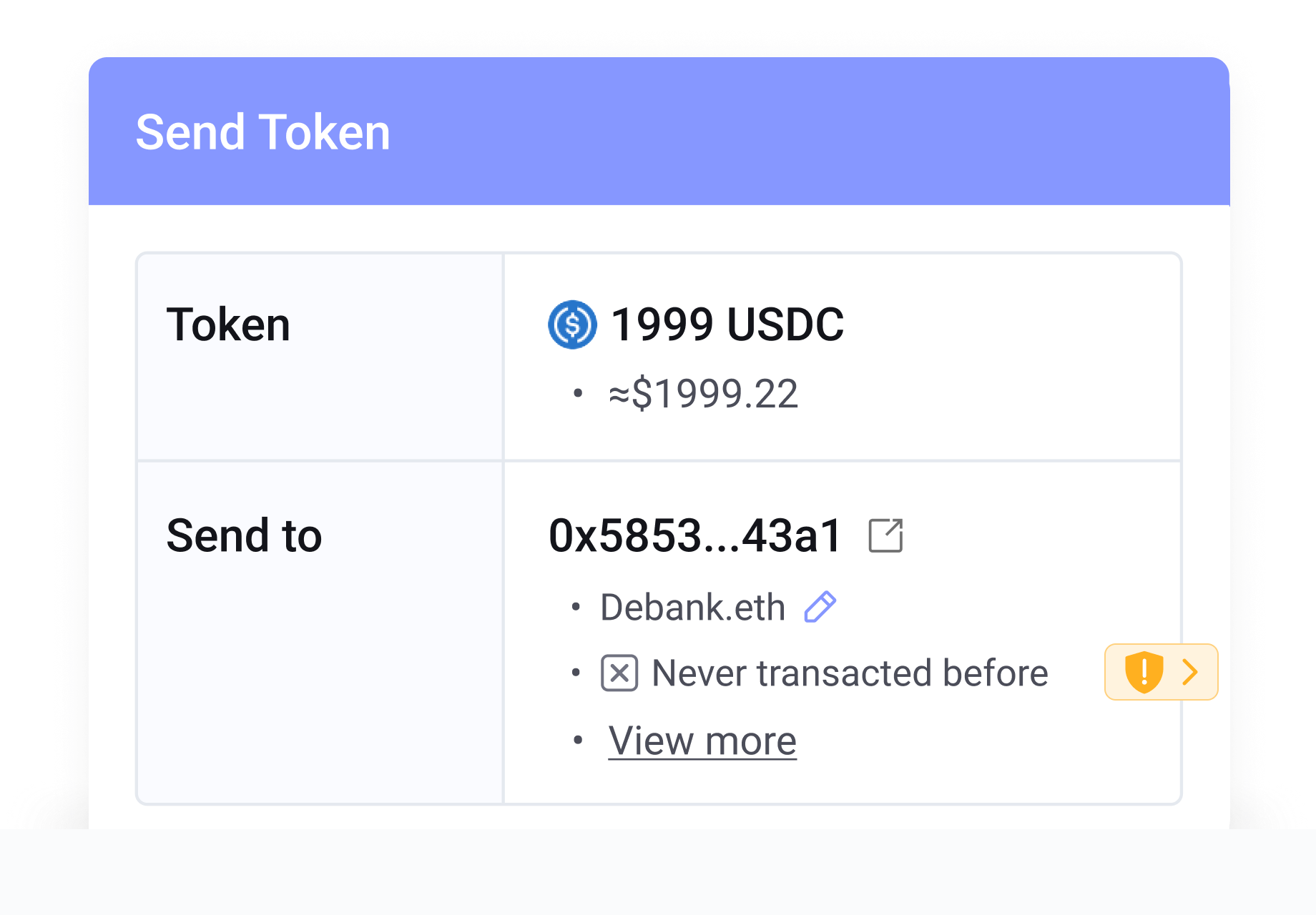
At its core, transaction simulation is a dry run of the EVM (Ethereum Virtual Machine) call graph your signed transaction would execute. Rabby takes the transaction payload returned by a dApp, replays the call sequence in a local or remote simulator, and computes the expected state changes: token transfers, approval modifications, and gas fees. It then surfaces plain‑language outputs — an estimated token delta, the explicit fee in native gas token, and alerts if the simulator encounters a suspicious pattern (for example, a direct drain to an unknown recipient or a call into a contract with a history of hacks).
Two implementation details matter for security and accuracy. First, the simulator must run against the right chain state: block number, nonce, and contract code must match the real network at the moment of signing. Rabby addresses this by coupling auto network detection with on‑demand state queries; when you interact with a dApp, Rabby attempts to switch to the correct network and use up‑to‑date node responses. Second, interpreting the simulation requires heuristics: Rabby’s engine flags patterns like “approval for unlimited allowance” or “proxy contract with upgradeable logic” based on metadata and past incidents. These heuristics are policy judgments, not proofs — useful, but fallible.
What simulation protects you from — and what it cannot
Transaction simulation meaningfully reduces the risk of two common classes of user errors: accidental approvals (giving a contract unlimited access to your ERC‑20 tokens) and unexpected token drains due to malicious UX or deceptively labeled dApp flows. By showing the exact token balance deltas before signing, Rabby turns a blind signature into a readout you can audit.
However, simulation is not magic. It cannot protect you fully in these cases: (1) If the contract you are about to interact with is itself malicious but obfuscated such that the on‑chain code only reveals harmful behavior after a future upgrade through a governance action or proxy pattern; (2) If the simulator is fed incorrect state because of a compromised RPC provider; or (3) If a user self‑defeatingly approves an action despite clear simulated deltas (social engineering at the UI level). Also, replaying complex cross‑chain flows can be imprecise: cross‑chain bridges and asynchronous settlement mean the simulator can only produce an estimated result, not a guaranteed final state.
Trade-offs: security signals vs. friction and coverage
Integrating simulation into the UI introduces friction. Every simulation adds latency to a fast swap, and for power users executing many transactions, that latency compounds. Rabby tries to minimize friction via automatic network switching and presets, but latency and occasional false positives are structural trade‑offs. A tool that warns constantly becomes noise; one that is silent misses threats. The engineering judgment is balancing sensitivity (catching true problems) against specificity (avoiding irrelevant alarms). Rabby’s open‑source model helps here: the community can inspect heuristics and propose tuned rules, but that also means users must trust ongoing maintenance.
Coverage is another tension. Rabby supports over 90 EVM chains and connects to hardware wallets and institutional solutions such as Gnosis Safe and Fireblocks. This breadth raises the surface area for both valuable functionality and potential gaps: simulation on a less common chain may depend on less reliable RPCs or indexed metadata, producing weaker warnings. In short: more chains = more utility, but also more places where simulation quality can vary.
Installation and integration — practical tips for US power users
Installing the Rabby extension is straightforward for Chromium‑based browsers and the developer has made a point of compatibility with major hardware wallets. In practice, power users should follow a short preflight checklist: use a dedicated browser profile, connect through a trusted RPC (or your own node) where practical, and pair Rabby with a hardware wallet for high‑value accounts. Wallet flipping — Rabby’s toggle to switch between it and MetaMask — makes migration less disruptive during the transition period.
One practical detail: Rabby does not have a built‑in fiat on‑ramp, so US users subscribing to convenience should plan for separate custody steps to convert USD to on‑chain tokens. Likewise, if you require native staking inside the wallet, expect to rely on external staking interfaces or integrated multi‑sig solutions for institutional workflows.
When installing, verify the extension source (use official channels), enable hardware wallet integration if you use a Ledger or Trezor, and review the approval revocation tool immediately: revoke legacy unlimited approvals before you begin active trading. That small housekeeping step reduces downstream exposure more than almost any other single action.
Security history and realistic trust calibration
Rabby is open source under MIT license, which raises the bar for independent auditing and community scrutiny. That transparency matters. It also matters that the project suffered a smart contract exploit in 2022 associated with Rabby Swap; the team responded by freezing the contract and compensating victims. This episode is an instructive example rather than a fatal flaw: it shows both that bugs can exist even in well‑designed ecosystems and that rapid incident response and remediation are important governance signals when assessing a wallet’s operational maturity.
For US users and institutions, that episode should encourage a layered trust model: rely on Rabby’s simulation and pre‑transaction scanning as a technical control, but combine it with organizational controls (multi‑sig, hardware wallets, limits on daily transaction volume). Integration with enterprise providers (Gnosis Safe, Fireblocks, Amber) is a practical route to scale security while retaining DeBank’s UX innovations.
One reusable heuristic for decision-making
Here’s a simple three‑part heuristic for choosing whether to make Rabby your primary extension: (1) Value alignment: Do you need multi‑chain access + granular security signals? If yes, Rabby fits. (2) Risk posture: For high‑value accounts, require hardware wallets and multi‑sig even with Rabby’s simulation. (3) Operational control: Use a trusted RPC or run your own node for critical flows; accept that simulation is probabilistic, not deterministic. If you answer yes to all three, Rabby is a strong candidate. If you answer no to any, plan compensating controls.
For a focused installation and an honest evaluation, start with a low‑value account to validate RPC behavior, simulate common trade types, and test the approval revocation workflow. That practical experiment will reveal how often simulations produce warnings you need, and whether those warnings reduce or increase friction in your operational environment.
For more detail on the wallet and how to install it across platforms, consider reviewing the official installer and documentation at rabby wallet.
What to watch next
Signal-watchers should monitor three things: (1) improvements in simulation fidelity — better state synchronization, on‑chain traces, and cross‑chain modeling; (2) adoption among institutional custodians and whether that leads to stricter feature gating or audit requirements; and (3) regulatory developments in the US around non‑custodial wallets that could affect merchant integrations or fiat on‑ramp partnerships. Each of these factors changes the practical risk calculus for deploying Rabby at scale.
FAQ
Does Rabby prevent all smart‑contract hacks by simulating transactions?
No. Simulation reduces certain classes of user error (blind signing, unexpected token deltas) but cannot fully prevent hacks that exploit contract upgradeability, compromised RPC providers, or off‑chain governance triggers. Treat simulation as a layer in a defense‑in‑depth strategy, not a silver bullet.
Is Rabby compatible with hardware wallets and multi‑sig for institutional use?
Yes. Rabby integrates with many hardware wallets (Ledger, Trezor, Keystone, etc.) and supports institutional and multi‑sig solutions such as Gnosis Safe, Fireblocks, Amber, and Cobo. For high‑value operations, combine Rabby’s simulation with hardware signatures and multi‑sig policies.
Will simulation slow down my trading?
It can add latency, especially on slow chains or when RPC responses are delayed. Rabby aims to minimize this through automatic network switching and optimized state queries, but power users executing many trades should factor in added milliseconds-to-seconds per confirmation and plan batching or dedicated nodes where speed is critical.
Can I buy crypto directly inside Rabby with USD?
Not currently. Rabby lacks a native fiat on‑ramp, so US users must acquire tokens through exchanges or third‑party services and then import assets into the wallet. This is a known limitation and a trade‑off for the focused security and multi‑chain approach Rabby takes today.
